Ep 8 - HSSIB Retained Sponges Report - Part I
Show notes
The Health Services Safety Investigations Body (HSSIB) investigates patient safety concerns in the UK. They are an independent body with the aim of making healthcare safer.
The reference event: Helen’s CABG
Helen had surgery for CAD (CABG x3 “triple bypass open heart surgery”). The procedure involved opening Helen’s chest to expose her heart and took approximately 5 hours to complete.
The day after the procedure, Helen had trouble breathing and a healthcare provider was concerned that she may have a pneumothorax. At 2:30 pm CXR was performed, and while “[i]t was documented that the Chest X-Ray (CXR) appeared cloudier on the left midzone and base of the chest,” there was no pneumothorax identified.
At 5:30 pm another CXR was taken and an opaque object was identified. The CXR was discussed with the surgeon and there was a concern of a retained sponge. Another CXR was completed at 7 pm and it confirmed a retained sponge.
At 1:30 pm, she went to the OR and had the sponge removed. As she was quite unstable, the decision was made not to X-ray her in the OR and to close her chest and stabilize her. At 7:30 pm, a CXR identified a second sponge in the same location as the first. The following morning, she had another surgery to remove the swab from her chest. A CXR performed in the OR showed no foreign objects.
Helen was in the ICU for 7 days and was discharged 13 days after her final surgery to remove the second sponge. At home, Helen had ongoing health problems and a difficult recovery. Helen’s family referred the incident to the HSSIB.
An investigation was started to identify factors associated with the unintentional retention of foreign bodies; and to identify alternative safety controls to reduce the risk of these events.
When the investigators first met Helen six months after the incident, she was visibly upset by what had happened and she reported she had received limited mental health support. According to the report, Helen continues to have health and wellbeing issues.”
Background and context
Investigation began: Sep 28, 2022.
Interim report: Dec 7, 2023 (14 months later) highlighted common themes in 31 serious incident reports (investigations carried out by local healthcare trusts).
Final report: Apr 16, 2024.
Never Events
Defined as ‘patient safety incidents that are wholly preventable where guidance or safety recommendations that provide strong systemic protective barriers are available at national level and have been implemented by healthcare providers’ (NHS Improvement, 2018).” [emphasis added]
Multiple UK reports call for Never Events to be renamed because the events described are not entirely preventable, there are not strong barriers available to prevent them, and by calling them Never Events, it invites stigma and shame and discourages reporting and thorough investigation.
“The count” / reconciliation
Sponges are counted in a specific way, by two nurses, who must agree on the count before the sponges are used. They are counted
at the start of a procedure,
Before the closure of a cavity,
Before the first layer of muscle is closed, and
Before wound closure begins.
A final count is performed at the beginning of closing skin or before the end of the procedure
Analysis and findings regarding the reference event (Helen’s CABG)
The HSSIB: “Limitations in the evidence meant it was not possible to identify precisely what happened during Helen’s surgery to result in two swabs being retained. Very few notes were made in Helen’s medical record during the procedure, so the investigation relied on staff recall of events. To gather more information about how swab reconciliation works in practice, the investigation observed a coronary artery bypass graft (CABG)” and a lobectomy
It is curious that the first finding of this report is that the available evidence made it impossible to determine precisely what happened during Helen’s surgery, yet there is no mention of recording devices in the report. In aviation, when airplanes crashed in the 1950’s and 60’s, they had to invent a robust means of recording what occurred in order to determine what happened and how to prevent future accidents. In this case, OR Black Boxes would almost certainly have provided the evidence needed. And patients continue to be placed at risk by the unavailability of this information.
The investigation considered
Factors affecting the sponge count
Factors affecting the detectability of the sponges in Helen’s chest
Why the sponges were not initially identified on CXR
Factors affecting detection of the second retained sponge
Factors affecting the sponge count
responsibility for swab counts (surgeon vs scrub nurse)
communication of information about swabs
Surgeons not informing scrub nurse when a sponge was inserted
Inserted sponges not always being recorded on the count board (a whiteboard in the OR) - lack of verbalization, or not hearing (readback, hearback: “sponge in” “rog”). The report notes “communication not being acknowledged or being ignored”, noise, “confidence of staff to speak up”; nurses said they felt ignored by the surgeons when raising concerns. (Some trusts implemented assertiveness training / terminology such as “STOP I have a concern” to empower them. In the reports, these new practices were not always being used or this was being ignored by surgical teams.
“‘The scrub nurse repeated this several times asking for everything to stop whilst the count was performed again and an attempt made to locate the swab. No verbal recognition of the information given to the surgical team was made.”
visibility of swabs
Not in direct line of sight
Soaked with blood and therefore lacking contrast with surrounding tissue
Radiopaque stripes appear similar to other lines on XR and when an XR is performed for another reason, no one is looking for a sponge.
the make-up of the operating theatre team
When there is a change of nurses, the count wasn’t always being conducted between the outgoing and incoming nurses
the timing of the count and its confirmation at Sign Out
In some cases, the skin had already been closed when the final count was performed.
Lack of clear communication or the surgeon assuming that since they had been handed instruments to close, the count must be correct.
the type and duration of the surgical procedure
Most common in laparotomy (abdo surgery) and in surgeries lasting > 4h or < 1h
professional culture and practice
Surgeons taking swabs directly from the nurse’s table without informing the nurse.
Consultant surgeons leaving the OR and letting junior members close
distractions and interruptions
competing tasks - counting while doing other tasks
time pressure
time of day
More common in surgeries between 2 pm and 7 pm, raising concerns of fatigue (HSSIB noted further data are required here)
clarity of policies and procedures - lack of clarity on specific times counts are to be performed
The report again identifies weaknesses in the level and quality of the evidence available in the investigation and finds that there may be other factors that affect the reliability of the count that could not be identified because of that. Yet another reason for OR Black Boxes.
The final report conducted an indepth Hierarchical Task Analysis of how sponges are counted and broke it down into a hierarchy of key goals, sub-goals, actions, and plans.
Investigators noted that scrub and circulating nurses were required to count 235 different items for a CABG. In some cases, there were over 200 needles and over 50 sponges.
The cardiac OR was noted to be “intense and busy” and there were critical stages of the surgery for a CABG.
At quieter times in the procedure, the scrub nurse removes used sponges from the surgical field (to limit the number of sponges in the field) and puts them in bags, five at a time and then they are crossed off the count board. Once they are in the bags, however, it is difficult to see how many there are.
Given the various locations of the sponges (clean sponges on the scrub table, partially used sponges on the patient, used sponges in the patient, etc) there is a risk that sponges can be counted incorrectly.
While the surgeon remains overall responsible for the count, surgeons generally say that they are not involved in the count other than to confirm there are no sponges in the patient.
Factors affecting the detectability of the sponges in Helen’s chest
Sponges come with tails, but these were cut off before the sponges were used.
The NHS later adopted a policy of never cutting off the tails or altering the sponges, but only a few specialties needed sponges without tails and they were not available because it was not cost effective to buy them as of the date of this report.
Sponges absorb blood and then look like tissue.
Sponges can be very deep in a cavity and be obscured from view by organs.
Factors affecting the detectability of the sponges on x-ray
There were many other items visible on the CXR (tube, lines etc) making the sponges more difficult to detect.
The clinicians were focused on other theories for Helen’s deterioration.
Factors affecting detection of the second retained sponge
Staff thought there was only one sponge.
Helen was unstable and it was deemed unsafe to conduct an extensive search of the chest cavity or an X-ray.
Analysis and findings of the wider investigation
The low frequency of retained foreign objects following invasive procedures indicates that the counting system is largely successful, however, counting items is not a strong systemic barrier and these events can still occur.
There is a tension between spending more time on something that seems to be largely working well (the count) and the need to be efficient with operating room time (or else harm comes to patients).
HSSIB explicitly identifies the conflict that is present in frontline healthcare workers’ minds: ‘every minute that is spent attempting to improve a process that works most of the time is a minute of OR time that another patient cannot receive’
The HSSIB resolves this tension by pointing out that while ‘Frontline workers generally operate under rules and procedures which provide a normative standard against which their behaviour can be judged. In contrast, designers, managers, and such generally operate with more degrees of freedom.” Meaning we may be able to design better sponges and use system measures rather than people-focused measures to reduce this risk without a tradeoff.
OR Black Boxes & Medical Culture
Adam raises idea that surgeons’ lack of adherence to SOPs (calling out when a sponge goes into a cavity) was identified as a factor and that could be strengthened, but this runs counter to medical culture and without strong evidence (i.e. OR black boxes), this would be difficult to change.
Amir pushes back on this idea, as people-focused interventions are not the strongest barrier and therefore, strengthening this barrier is not as high yield as redesigning the sponges. Additionally, he identifies the concern that this a return to the local investigation reaction of “Nurse/Doctor do it better”.
Adam agrees with Amir, but suggests a parallel to aviation that he’s seen: some aviation accidents occurred where the Captain’s lack of adherence to SOPs was identified as a contributing factor. When this was investigated, it was often found that the Captain’s behaviour was permitted by the company's culture. The only reason this can be analysed is through the use of the black boxes.
A discussion about the acceptance of OR Black Boxes ensues. Amir suggests that the medicolegal landscape, including the medical culture, must change before full acceptance of OR black boxes can occur. Adam suggests that HSSIB reports and the evidence provided by such black boxes shapes medical culture, rather than the other way around. The strongest indicator of this, in his view, was that CRM came into being because of aviation accident reports which relied on the evidence gathered from the black boxes.
Both agree that black boxes will eventually find their way into the OR.
Adam agrees that there are legitimate concerns that must be addressed and even if addressed at the outset, these concerns will need to be guarded against throughout the use of this technology, just as it has been in aviation.
Safety intervention worth mentioning: The Hierarchy of Intervention Effectiveness (see diagram)
In North America, medical culture places the emphasis on the frontline staff (doctors, nurses, allied health professionals) to get it right and when incidents are made known to staff, there is an expectation that that awareness should be sufficient to prevent it from recurring. This is as opposed to changing the working conditions, which is Professor James Reason’s main conclusions in his life’s work.
In the interim report, the HSSIB refers to “The Hierarchy of Intervention Effectiveness” from Cefazzo and St-Cyr, 2012, which shows various interventions and their relative effectiveness.
As the report describes, “The hierarchy is a tool for ranking the effectiveness of measures used to reduce the risk of a safety event. Measures that rely on people are considered to be less effective.”
“Many of the serious incident investigations reviewed were limited in their application of a systems-based approach. A systems-based investigation approach is based on the idea that safety incidents or accidents cannot be attributed to the behaviour of an individual component of the system and behaviour should only be considered within the context of the whole system. [...] For example, a systems-based approach might consider the interrelationships between factors such as task complexity, technology, stress, fatigue, culture, organisation influences, equipment and environment.”
“The serious incident reports tended to focus on the actions of clinical staff. They included limited exploration of why things happened or consideration of the context in which the retained swab event took place, what made sense to staff at the time and the wider system factors that influenced the event. As such, many of the serious incident reports implied blame on individual staff members.”
The HSSIB’s review of local incident investigation aligns with what we’ve seen in our earlier episodes and with what Amir and Adam see as clinicians in Canada.
The solution is to change the working conditions, and, as the hierarchy tells us, systems-based approaches are far more effective than people-focused ones. i.e. More standardization, computerization, and forcing functions (changing the physical sponges possibly to include RFID tags) is the most effective intervention to take and re-designing the count to take into account human factors will help, but ultimately would not be as strong a barrier on its own.
Health Services Safety Investigations Body (HSSIB) reports
HSSIB Report: Retained swabs after invasive procedures (April 16, 2024)
HSSIB Interim Report - Retained swabs following invasive procedures: themes identified from a review of NHS serious incident reports (December 7, 2023)
HSIB Legacy Report: Detection of retained vaginal swabs and tampons following childbirth (June 7, 2021)
Other resources
Willful Blindness by Margaret Heffernan
Selective Attention Test (Simons & Chabris, 1999, YouTube) (1 min)
Cognitive bias in diagnostic radiology (radiopaedia.org)
Random recommendations
Adam: Go see the RCAF Snowbirds! 2026 Schedule
Snowbirds to be grounded after the 2026 season until 2030 when they acquire new aircraft (CBC: May 19, 2026)
Amir: Be a tourist in your own city
Some of the links in these show notes are Amazon affiliate links. As an Amazon Associate, we may earn from qualifying purchases, at no additional cost to you. Currently, we receive no outside funding, so we thank you for supporting the podcast, again at no additional cost to you.
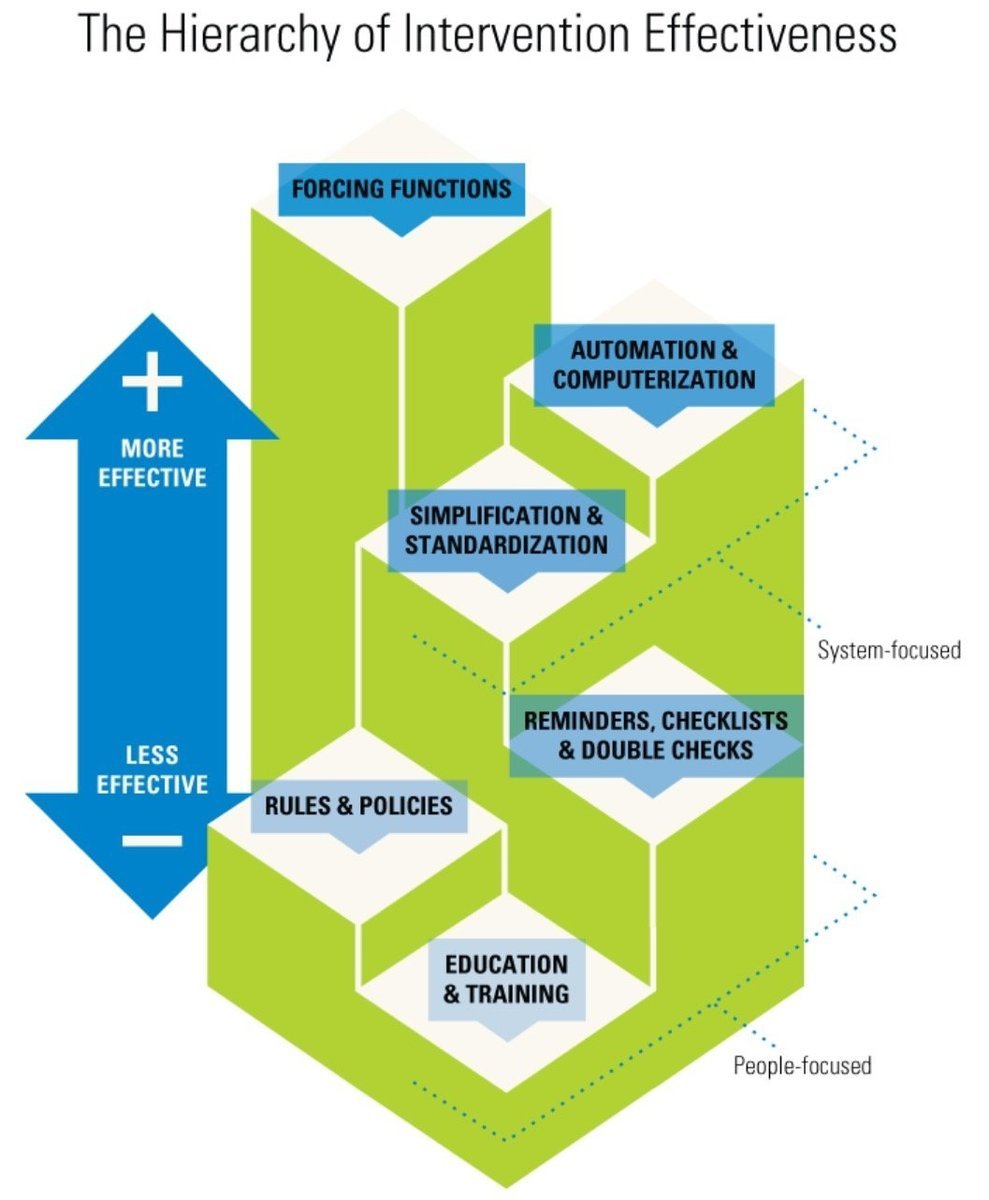

(HSSIB Retained swabs following invasive procedures) Figure 9: Hierarchy of intervention effectiveness (image from Cafazzo and St-Cyr, 2012)